Is There a Difference Between an Emergency Room and a Hospital?
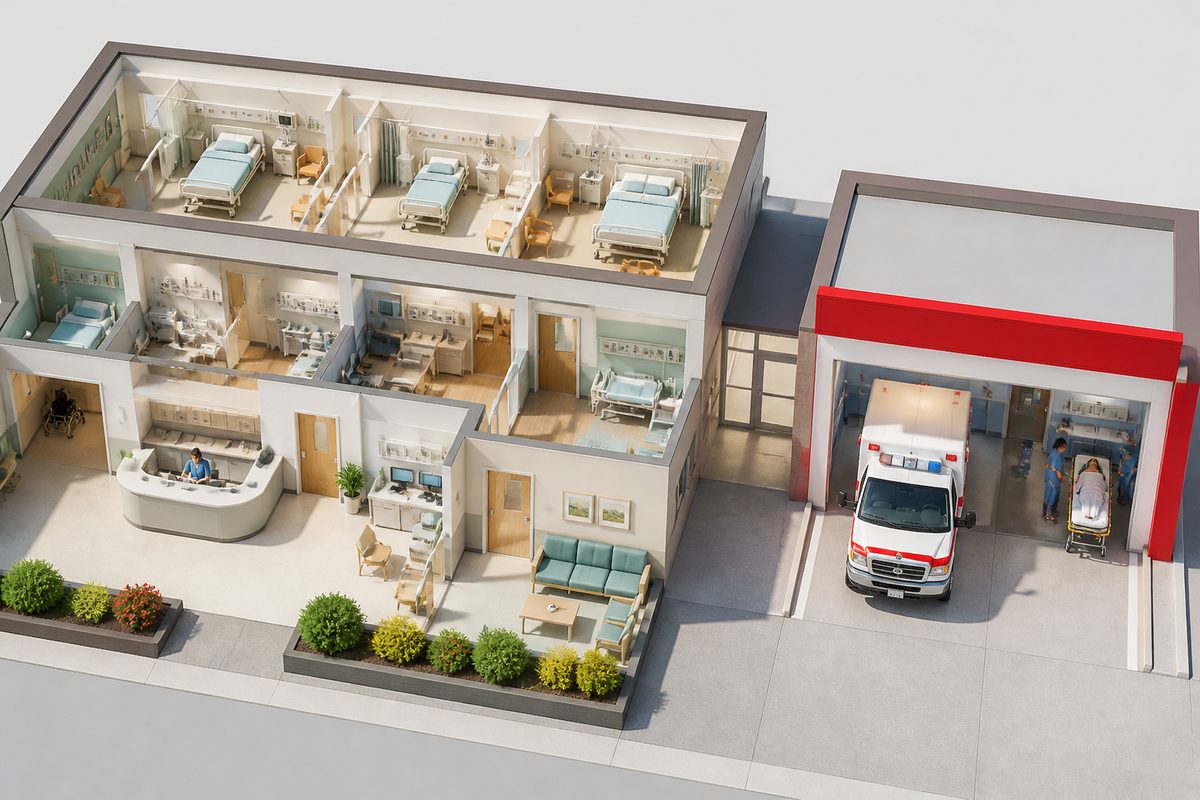
Yes: an emergency room is one department inside a hospital, while the hospital is the whole organisation that also runs wards, operating theatres, specialist clinics and much more. In Australia the emergency room is usually called the emergency department, or ED. It's the part of the hospital built to assess and steady people with urgent or life-threatening problems, around the clock.
This guide explains how the two relate, why the difference matters, and how to think about which door to walk through. It's general information only. It can't diagnose or advise on your own situation.
If you or someone near you may be in a life-threatening situation, call 000 straight away. For health advice on whether to seek care, healthdirect offers a service on 1800 022 222, and Queensland readers can call 13 HEALTH.
The simplest way to picture it
Think of a hospital as a big building with many services under one roof. The ED is the busy front entrance for unplanned, urgent arrivals.
Most patients who stay overnight don't pick a ward. They come in through the ED, get assessed, and are then sent home or admitted to another part of the hospital.
The hospital as a whole can include:
- The ED for sudden illness and injury
- General and specialty wards for people who need to stay
- Operating theatres for planned and emergency surgery
- Maternity and birthing services
- Outpatient clinics for scheduled appointments
- Pathology and radiology services
- An intensive care unit for the sickest patients
So when someone says they're going to the hospital in a crisis, they almost always mean the ED. When someone says they're in hospital for a week, they mean they're getting inpatient care on a ward.
One building covers both meanings. That's why the words get blurred in everyday speech.
What the emergency department actually does
An Australian emergency department is staffed by teams who practise emergency medicine. It's a recognised medical specialty focused on the first hours of unexpected illness and injury.
Their job isn't to manage every problem to the end. It's to work out what's dangerous, treat what can't wait, and decide what happens next.
That usually follows a sequence like this:
- Arrival and brief assessment by a nurse
- Triage, which assigns a priority level
- Examination and, where needed, tests
- Initial treatment and stabilisation
- A decision to discharge, observe or admit
The ED is also where resuscitation happens. Staff are trained in advanced life support, including cardiopulmonary resuscitation. The department has equipment and fast access to colleagues that a typical community clinic doesn't.
How triage decides who is seen first
People aren't seen in the order they arrive. Hospitals use a triage system to rank urgency. A well-known tool in many countries is the Emergency Severity Index, a five-level scale that sorts patients by how sick they are and how many resources they're likely to need.
Australian departments use their own national triage scale, which works on a similar idea. The most time-critical patients go first, and less urgent cases wait.
Many people find this frustrating. But a long wait doesn't mean you've been forgotten. It often means others with more dangerous conditions came first. If your symptoms change while you wait, tell the triage nurse promptly.
What the rest of the hospital adds
Once the ED has steadied a patient, the wider hospital takes over. This is where the second half of the picture matters, because the ED is built for short stays, not long treatment.
Inpatient care
Inpatient care means being formally admitted to a bed. Wards are organised around a type of condition or a medical specialty, such as heart, lung, bone or digestive problems.
Teams on those wards plan treatment over days, not hours. They review progress daily and organise discharge.
Intensive care
The intensive care unit looks after people who need close monitoring and support for failing organs, such as help with breathing. The field behind it, intensive care medicine, is another medical specialty with its own training path.
Not every hospital has one. That's one reason patients are sometimes transferred between hospitals.
Diagnostic services
Medical imaging such as X-rays, ultrasound and the CT scan is available in the ED for urgent cases. The wider hospital also runs these services for inpatients and outpatients.
A CT scan can show internal injuries or bleeding quickly, so it's often used when time matters. Whether you need one is a clinical decision made by the treating team. It's not something to ask for in advance.
Surgery and procedures
Operating theatres sit within the hospital, not the ED. The ED team may call a surgeon, but the operation itself happens elsewhere in the building.
Why not every hospital is the same
Hospitals differ a great deal in size and skills. A large city hospital may have a dedicated trauma centre, set up to receive people with serious injuries from major accidents, with surgeons and specialists on hand. A smaller regional hospital may have a modest ED, few specialists and a plan to transfer very sick patients onward.
This matters when you're choosing where to go, or when an ambulance crew decides for you. Paramedics may bypass the nearest hospital if another one is better equipped for the problem. That's not a delay for its own sake. It's matching the patient to the right level of care.
Some private hospitals also run emergency services, and others don't. Capabilities, opening arrangements and costs vary, so check with the provider rather than assuming.
Comparing the ED with other care options
Part of the confusion comes from how many places look alike. Here's how the main ones relate, in general terms.
- Hospital ED: for urgent and life-threatening problems, with the full hospital behind it.
- GP clinic: for ongoing health care, non-emergency problems, referrals and follow-up. Your GP knows your history and coordinates your care over time.
- After-hours GP services: options for problems that can't wait until the clinic reopens but aren't emergencies. Availability varies by area.
- Telephone health advice: a way to talk through symptoms with a qualified person and be pointed to a sensible next step.
In some countries you'll also hear about an urgent care center. That's usually a walk-in facility for minor injuries and illness, not attached to a hospital.
Australia has some similar walk-in services, often under different names and funding arrangements. The model isn't identical everywhere. Whatever the name, a free-standing clinic like this generally lacks the operating theatres, intensive care and specialist teams a hospital provides.
A note on rules from the United States
Some readers land here after reading overseas material. In the United States, a federal law called the Emergency Medical Treatment and Active Labor Act requires hospital emergency departments to assess and stabilise anyone who arrives with an emergency condition, regardless of ability to pay. That law doesn't apply in Australia.
Our public hospitals run under state and territory arrangements and national health funding rules. Your eligibility, any fees and any private insurance questions depend on your circumstances. Confirm current costs and eligibility with Services Australia or the provider before assuming what will or won't be covered.
Choosing where to go
Nobody can give you a personal verdict through an article. But some general principles help.
Call 000 for situations that look life-threatening or are getting worse fast. Don't drive yourself if you're unwell enough that it would be unsafe. And don't put off calling because you're unsure which hospital is closest. The operator will guide you and send the right help.
If you're not sure how serious something is, ring healthdirect on 1800 022 222, or 13 HEALTH if you're in Queensland, and describe what's happening. They can help you work out whether the ED, a GP or another service is the sensible next step.
If the issue is stable but you're worried, your regular GP or an after-hours GP service is often the right starting point. Using the ED for something a GP could handle can add to waiting times for others. But never hold back from calling 000 if you truly fear for someone’s life.
What to bring and say when you arrive
Whether you go to the ED or another part of the hospital, a little preparation helps the team help you.
- Photo identification and your Medicare card, if you have one
- Any private health insurance details
- A list of your current medicines as written on the packaging or by your pharmacy
- Known allergies and past conditions
- The name of your regular GP
- A phone charger and a support person if possible
Tell the triage nurse when symptoms started, what has changed, and anything that worries you. Honest, specific detail speeds up assessment.
Why the wording matters
It may seem picky to separate the ED from the hospital. But the difference shapes what you expect. The ED is built to answer urgent questions fast: is this dangerous, what must happen now, and where should this person go next.
The hospital is the system that delivers whatever comes afterwards. Knowing that sequence makes a visit less bewildering. It explains why you might be moved from one area to another, and why an ED stay doesn't always end with a bed.
It also helps when comparing places to get care. A walk-in clinic, a GP, the ED and a specialist ward are all part of the wider picture of health care, but they're built for different jobs. Picking the one that fits your situation tends to be quicker, safer and less stressful for everyone.
Finding your way through the options
If you'd like a broader overview of how to find the right kind of care, After Hours Care Guide is an independent guide to finding care. It doesn't provide medical services, it can't send a doctor, and it's not a substitute for emergency help or personal medical advice.
Key takeaways
- The emergency room, or ED, is a department within a hospital; the hospital is the whole institution.
- Most unplanned admissions begin in the ED and move on to wards for inpatient care.
- Triage ranks urgency, so waits reflect priority rather than arrival order.
- Hospitals differ in capability, and a trauma centre or intensive care unit is not found everywhere.
- Rules from other countries, including US law, do not describe how Australian services work.
- In an emergency, call 000. For health advice, call healthdirect on 1800 022 222, or 13 HEALTH in Queensland.
An emergency room is the department within a hospital that treats urgent and life-threatening conditions, while a hospital is the larger facility that also offers inpatient care, surgery, specialist units, and diagnostic services. Patients who arrive at the emergency room are assessed first, then either treated and discharged or admitted to other hospital departments. Some hospitals are designated as a trauma center, meaning they have the staff and equipment to handle severe injuries such as major accidents or falls, but not every emergency room is part of a trauma center.